A Month of Remembrance
For the next month, we’ll be sharing stories and artifacts from our collection to commemorate the sacrifice of a great generation of Canadians. Many of them left from small communities like this one, farm boys, mill hands, and shopkeepers’ sons who boarded a train at a village station and, in too many cases, did not come back.
Curator: Riley Christensen
Bond Letters
“Fellow Canadian:”
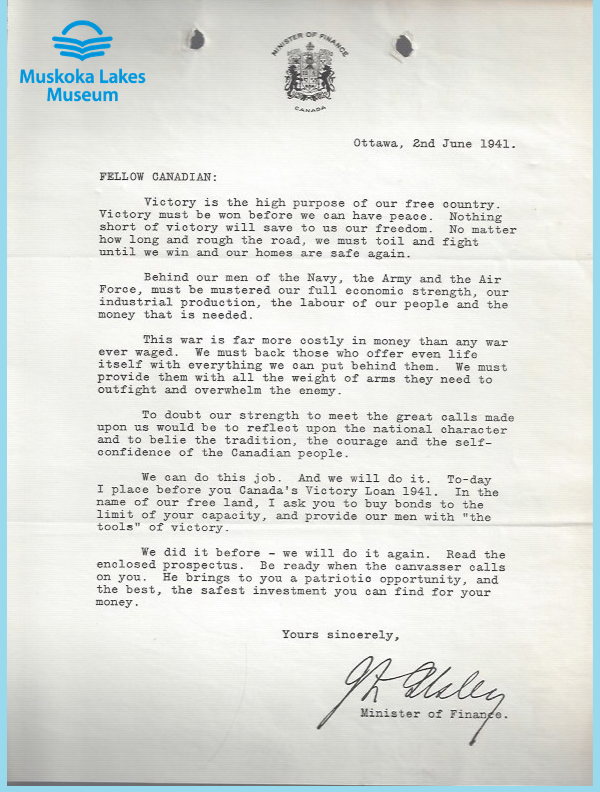
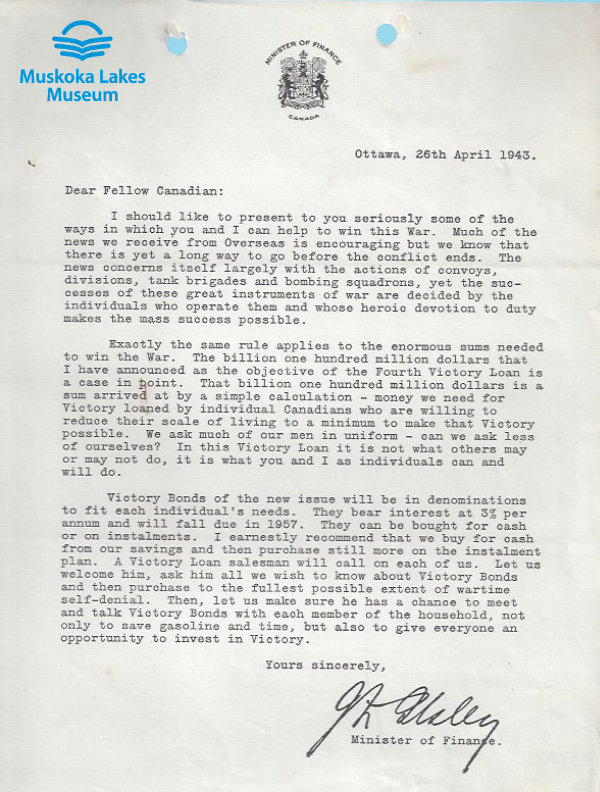
That’s how these two letters begin—one dated 2 June 1941 and the other 26 April 1943—both bearing the printed signature of J.L. Ilsley, Canada’s wartime Minister of Finance. They arrived in mailboxes across the country, including here in Muskoka, as part of the national Victory Loan campaigns.
The appeal was simple but enormous: lend the government your savings to finance the war. The 1943 letter sets the Fourth Victory Loan target at $1.1 billion, to be raised not from banks but from “individual Canadians who are willing to reduce their scale of living to a minimum.” The bonds paid 3% annual interest, matured in 1957, and could be purchased in cash or through instalments.
Look closely at the 1941 letter. Ilsley asks Canadians to provide our men with “the tools” of victory, with quotation marks in the original. It echoes Churchill’s famous February 1941 broadcast appeal: “Give us the tools, and we will finish the job.”
Remembrance often centres on those who served overseas. Letters like these remind us that the war was also fought at the kitchen table, through household budgets, instalment plans, and visits from Victory Loan salesmen.
982.3.63 & 982.3.64
Victory Bond
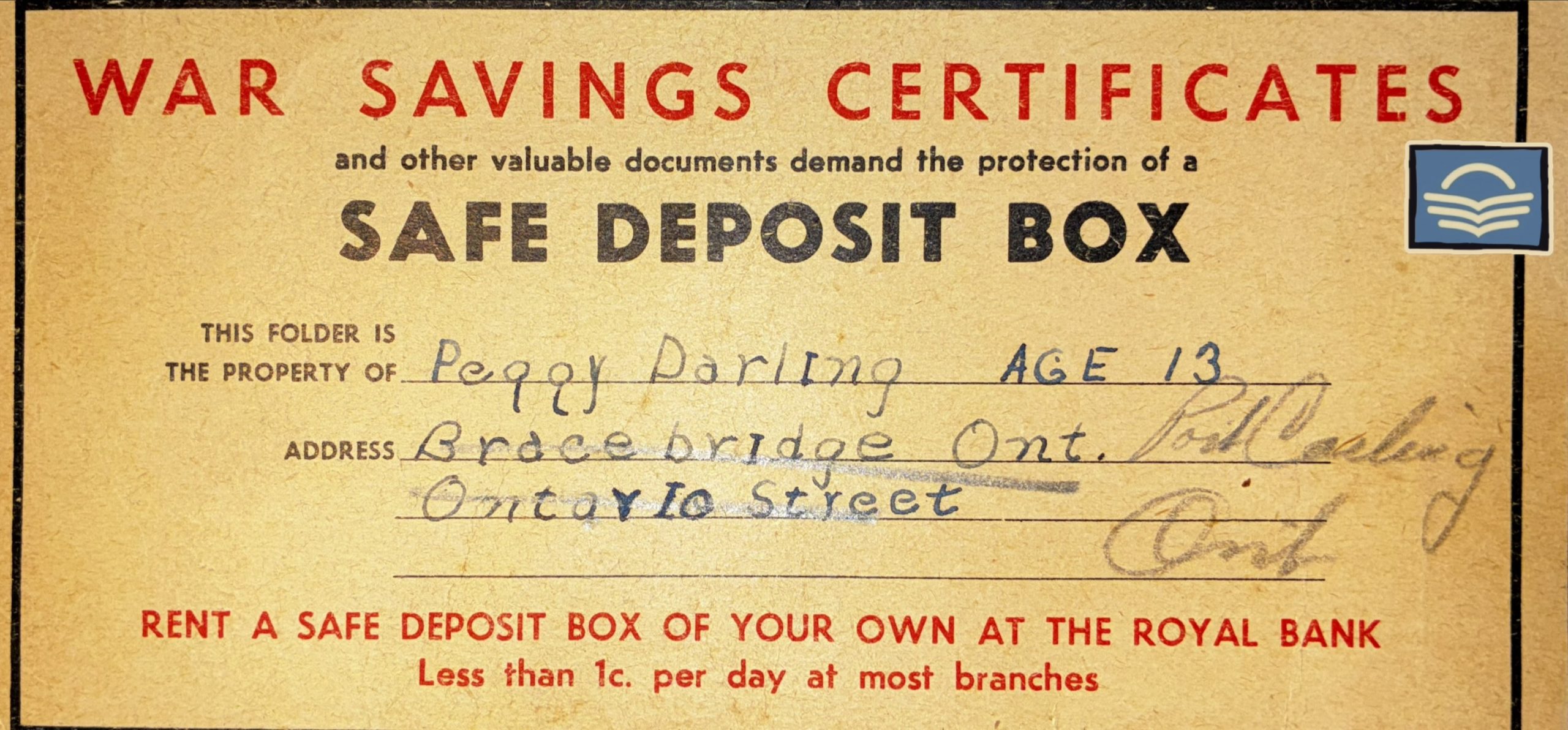
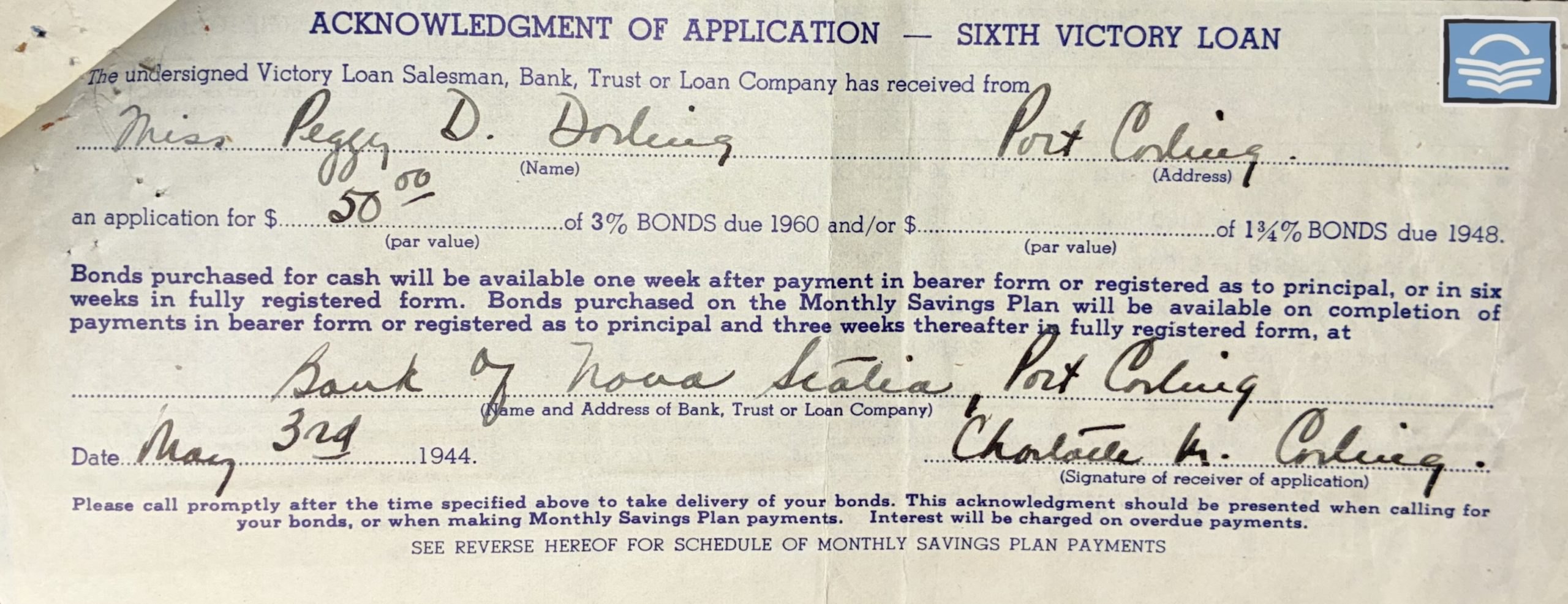
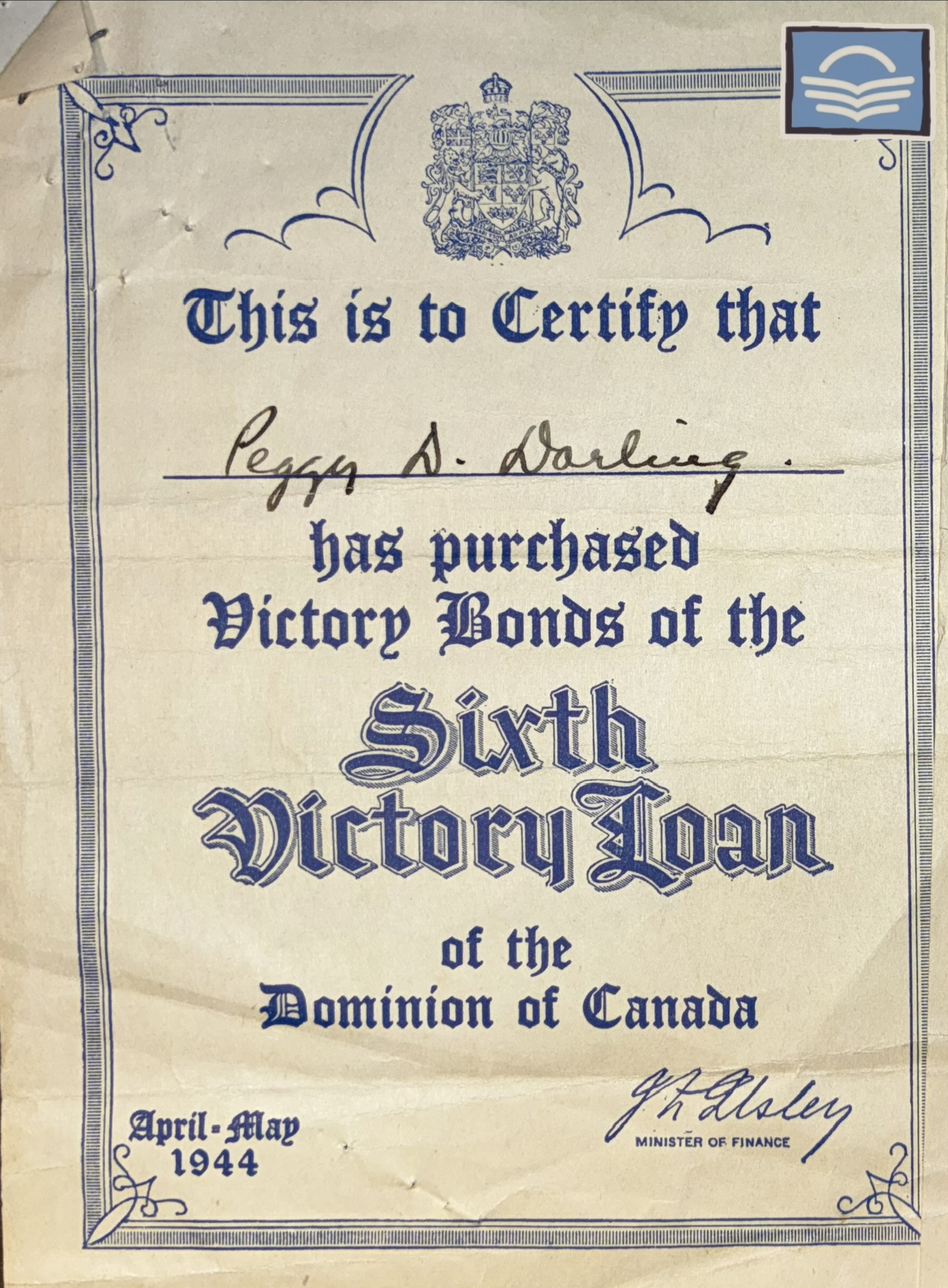
In May 1944, a thirteen-year-old girl walked into the Bank of Nova Scotia in Port Carling and bought a $50 Victory Bond.
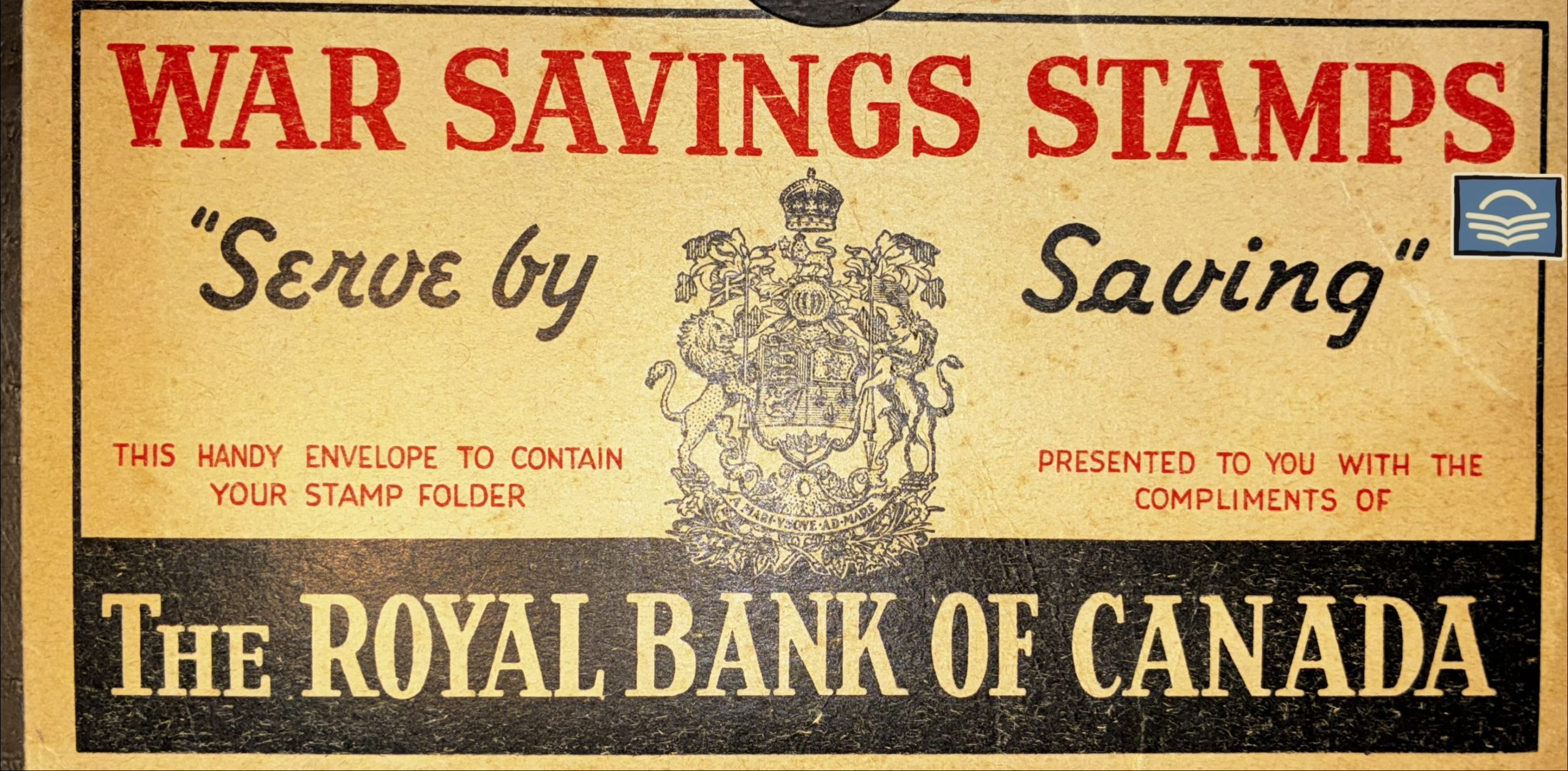
Her name was Peggy Darling. Her War Savings Certificates folder, filled out in her own hand and marked “AGE 13,” survives in our collection, along with her Sixth Victory Loan certificate and the receipt for her application: $50.00 in 3% bonds, due in 1960, dated May 3, 1944.
Peggy was answering a call that had been arriving in Canadian mailboxes since the war began. In June 1941, Finance Minister J.L. Ilsley launched Canada’s first Victory Loan of the Second World War with a letter to every household: “Victory is the high purpose of our free country.” By April 1943, the Fourth Victory Loan alone aimed to raise $1.1 billion from ordinary Canadians “willing to reduce their scale of living to a minimum.” As Ilsley put it, “We ask much of our men in uniform. Can we ask less of ourselves?”
Schoolchildren like Peggy saved a quarter at a time, pasting War Savings Stamps into folders until they added up to a certificate.
2016.19.5
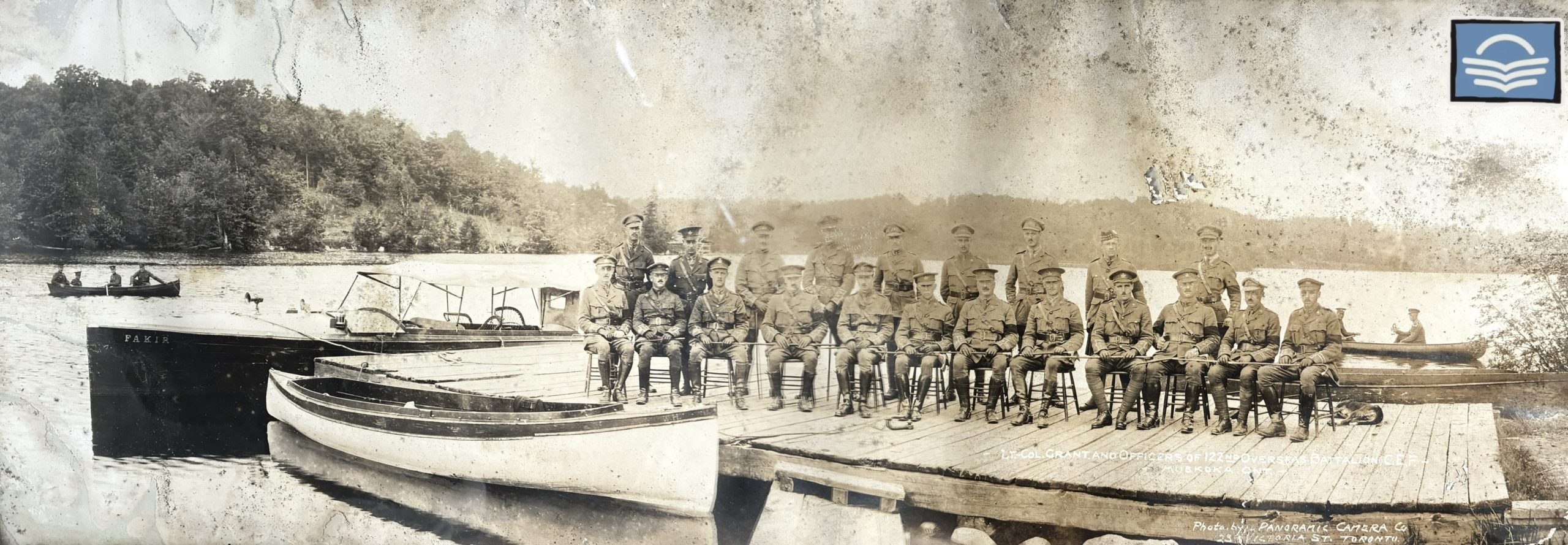
122nd (Muskoka) Battalion, CEF
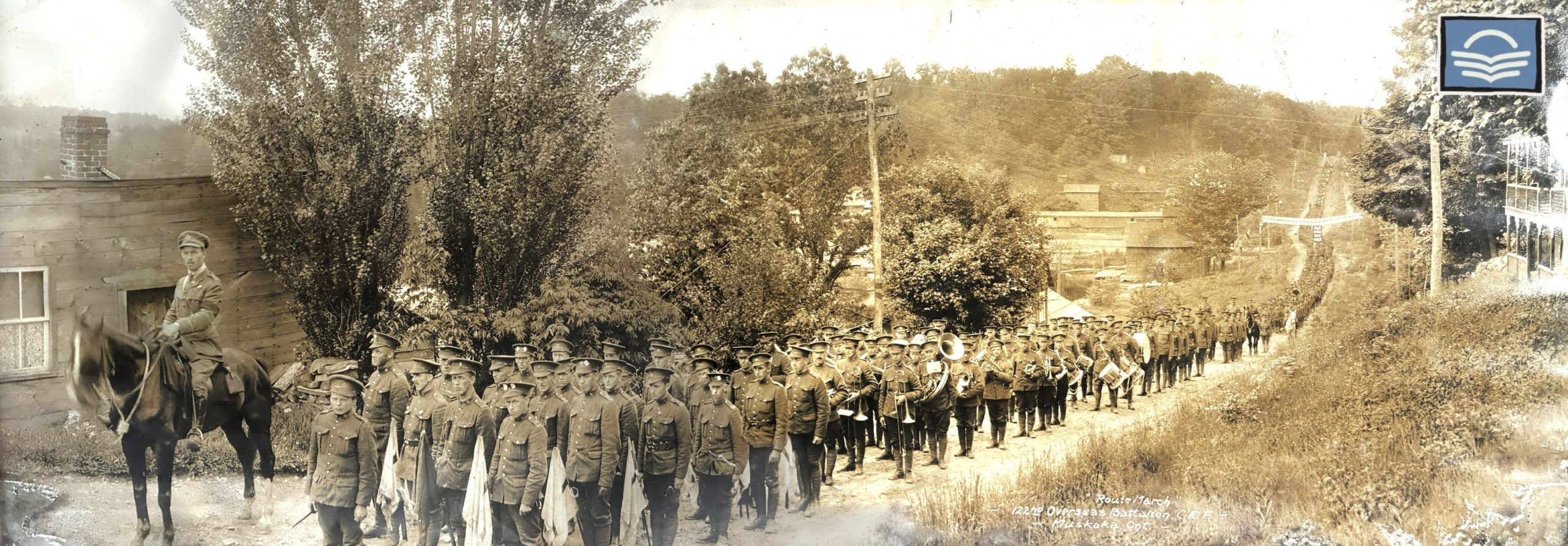
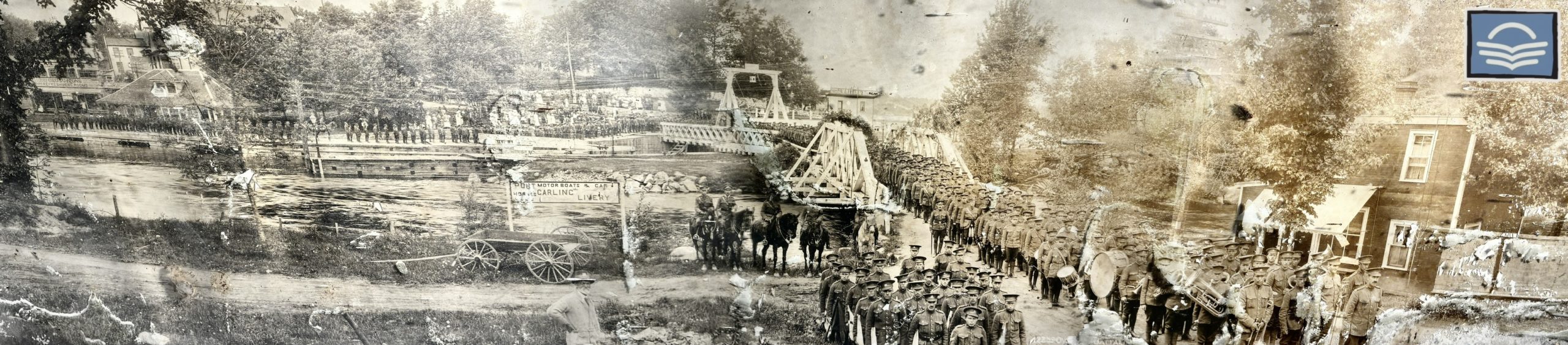
Three panoramas as follows: Lt.-Col. Grant and his officers posed on a boathouse dock; the battalion on a “Route March” behind its band; and the column crossing the garlanded swing bridge at Port Carling as the town lined the locks to watch.
The 122nd (Muskoka) Battalion, C.E.F., was authorized on 22 December 1915 and recruited across the district. It mobilized at Huntsville with a strength of 26 officers and roughly 686 other ranks under its sole commanding officer, Lieut.-Col. D.M. Grant. On 2 June 1917, it sailed from Halifax aboard the troopship Olympic.
It never fought under its own name. After reaching England on 9 June 1917, its men were absorbed into the Canadian Forestry Depot as reinforcements, and the 122nd was disbanded that September.
974.40.1, 975.21.1, 2008.4.2
The New Income Tax, 1942
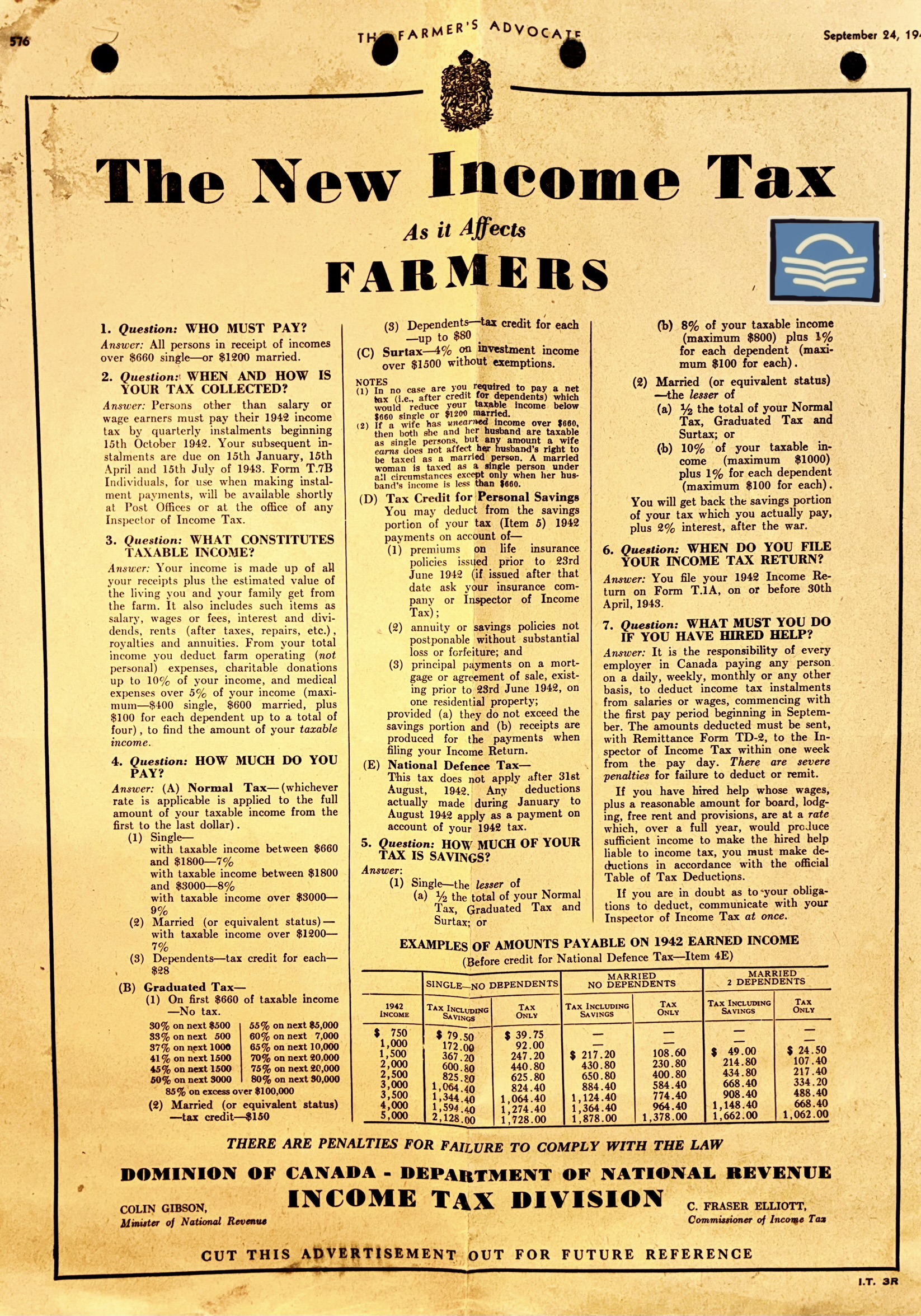
Until the Second World War, most Canadian farmers never had to pay a dollar in federal income tax.
This, however, was not because farming was exempt. Canada introduced income tax in 1917 to help fund the First World War, and it applied to everyone. However, the income threshold was set so high that most ordinary Canadians, farmers included, earned too little to pay. As late as 1938, barely 2% of Canadians filed a tax return.
The Second World War changed that almost overnight. To fund the war effort, Ottawa slashed the exemptions. By 1942, single people earning over $660 a year and married couples earning over $1,200 owed tax, with rates climbing steeply.
This full-page notice, published in The Farmer’s Advocate on 24 September 1942, explains the new reality farmers faced. Taxable income now included “the estimated value of the living you and your family get from the farm.” Even the food and shelter provided by the land counted as income. As you can imagine, the farming community was less than thrilled with this new development.
982.3.130